Learning Strategy, Programs & Platforms
The work that runs at organizational scale: a program built from zero, a platform consolidated for a whole company, and the vendors, budgets, and curriculum architecture behind them.

SoftwareOne Academy
A comprehensive learning program that also functions as a hiring pipeline for new graduates
Read the case →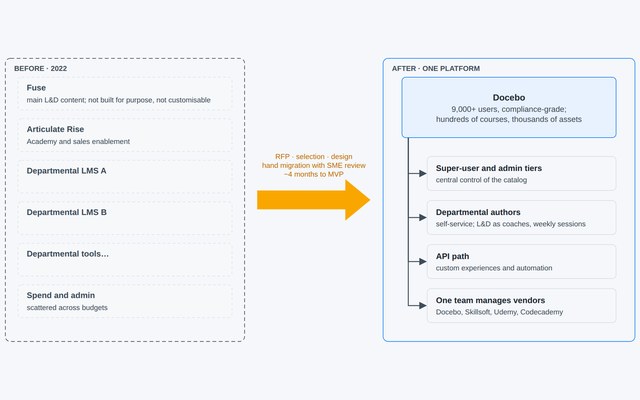
Docebo consolidation
One learning platform for 9,000+ people, in four months, migrated by hand
Read the case →Workday Talent: shipping the core, and proving what wouldn’t hold
I owned the implementation of Workday’s Talent module: I completed Workday’s required multi-day certification, then worked directly with their technical consultant to design the configuration and stand it up in the company’s test environment. The hard part wasn’t the software. It was that the company’s talent process was nonstandard, while Workday assumes a fairly fixed model of how a talent function works. Much of the work involved experiments and workarounds to fit our process into the system, followed by enough testing to show, with data, which customizations were too brittle to run in a real setting. We dropped those, shipped the core functionality with a change-management plan so the business could adopt it, and laid the groundwork for enhancements once the basics were stable. The real value was the judgment call: what not to ship.
Vendor strategy and spend: from a dozen accounts to one
In a large company, learning subscriptions accumulate the way tools do: five Udemy accounts here, ten Pluralsight seats there, each department paying its own way and none benefiting from enterprise features. I audited what existed, then worked with vendors, finance, and department heads to consolidate into single enterprise agreements, reducing cost while unlocking features and reporting individual subscriptions couldn’t provide. I also led the technical side of RFPs and contract reviews for larger platforms (Docebo, Skillsoft), validating that sales claims matched what the products actually did. I served as the ongoing point of contact for account managers at Docebo, Skillsoft, and Codecademy (pre-merger), as well as the smaller tools in use, ensuring issues were resolved and the company got full value for what it was paying. The formal budget sat with the head of L&D; vendor management and technical due diligence sat with me.
Mapping what a company actually needs to learn
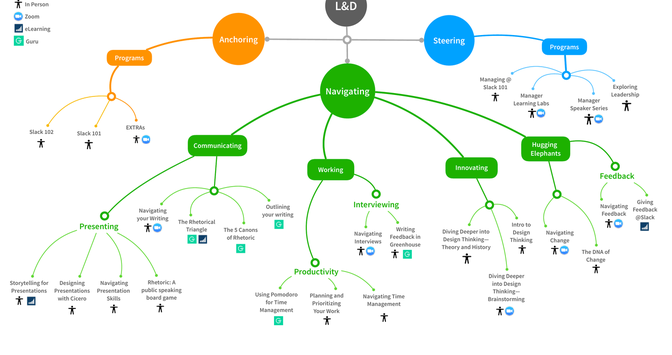
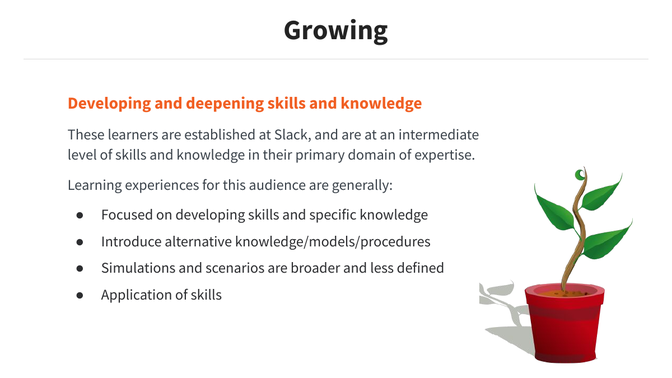
As one of the first Instructional Designers at Slack, I mapped the entire L&D function (what existed, who it served, and where the gaps were) using learner personas built from an analysis of a fast-growing employee population that skewed toward newer, less experienced employees. That map became the plan: the presentation-skills series, the writing workshop, and the communication and OKR programs all came out of it. At Apple, the equivalent artifact was a competency framework and content taxonomy for channel retail sales training: detailed enough to tag every learning asset and every branch of a simulation, so the content in the app could be organized by learning objective and curriculum sequence, and the groundwork for the adaptive paths the organization was moving toward. The pattern was the same in both cases: a strategy document specific enough to build from.