SoftwareOne Academy
A comprehensive learning program that also functions as a hiring pipeline for new graduates

Context
SoftwareOne is a global software and cloud services company with 9,000+ employees across dozens of countries. In 2021, it launched the Academy: a 13-week virtual boot camp that hires early-career candidates into a cohort, trains them for a specific practice, and places them into roles at the end. I was a founding member of the team, owning the curriculum, learning design, and program assets. I also ran early cohorts before handing day-to-day delivery to the practices. My team was distributed across Mexico, Germany, Spain, Romania, and Austria. Cohorts ran wherever the business needed them, from North America to France, Germany, Poland, Bulgaria, India, Colombia, Costa Rica, Singapore, China, the UK, and the Nordics.
The problem
The company needed a steady supply of people in cloud services roles (Azure, AWS, SAP, developer, cyber security, consulting, project management) that neither universities nor commercial boot camps were producing. The Academy deliberately recruited from local and regional colleges and apprenticeship programs rather than elite universities, which meant many participants were the first in their family to pursue post-secondary education and arrived with little grounding in how a corporate environment works. Each cohort had to finish the program able to do the job—and to function in the business—in thirteen weeks. And the curriculum had to be built and vetted at the speed of a company reorganizing as it grew, with cohorts sometimes shaped around a single practice in a single region.
What I did
I designed the Academy as a single program with two strands running across the full thirteen weeks. The role-based strand carried the technical curriculum for each participant’s specialization, built with practice leads and subject-matter experts and anchored on recognized certifications (Azure and AWS fundamentals, Microsoft 365). The professional skills strand covered what every early-career professional in a services business needs regardless of role: a core-consulting skills program (delivered by an outside consultant for the first cohorts, then brought in-house and rebuilt), business essentials, communication, customer service, productivity, and a personal development track.
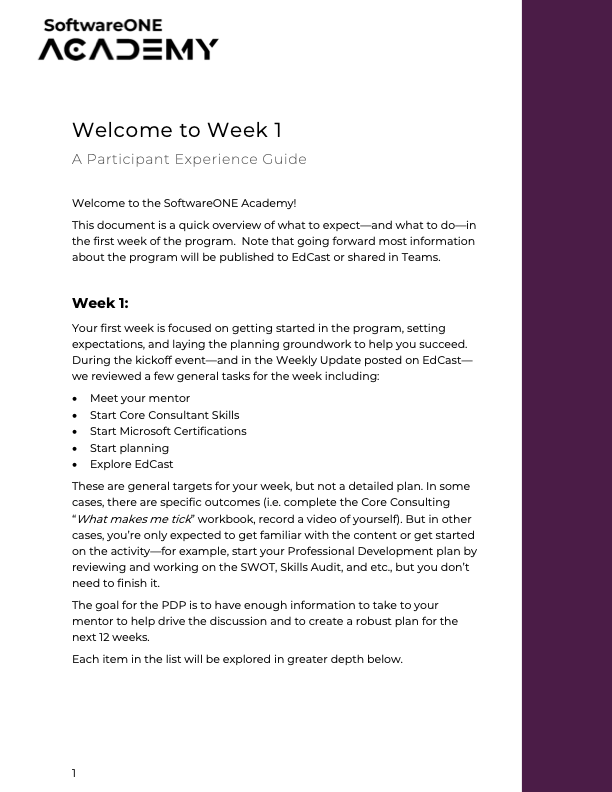
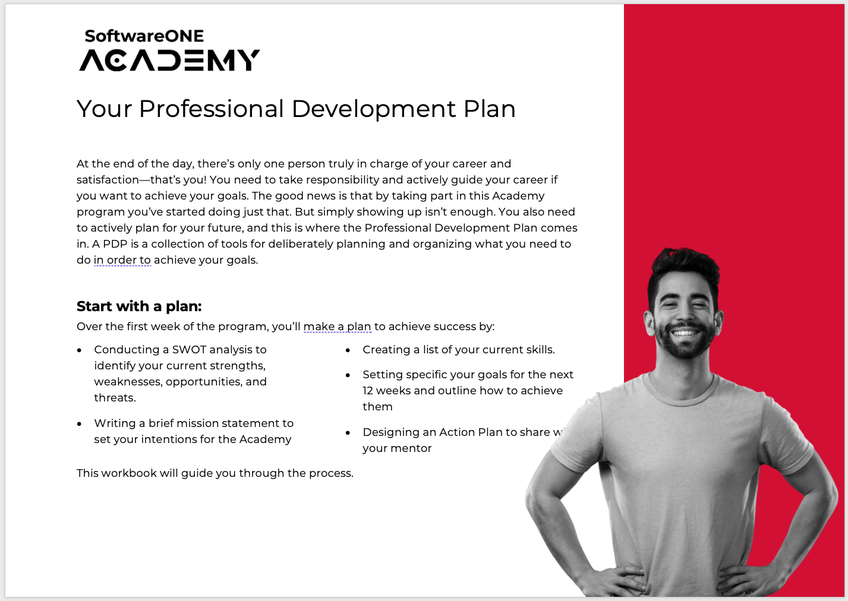
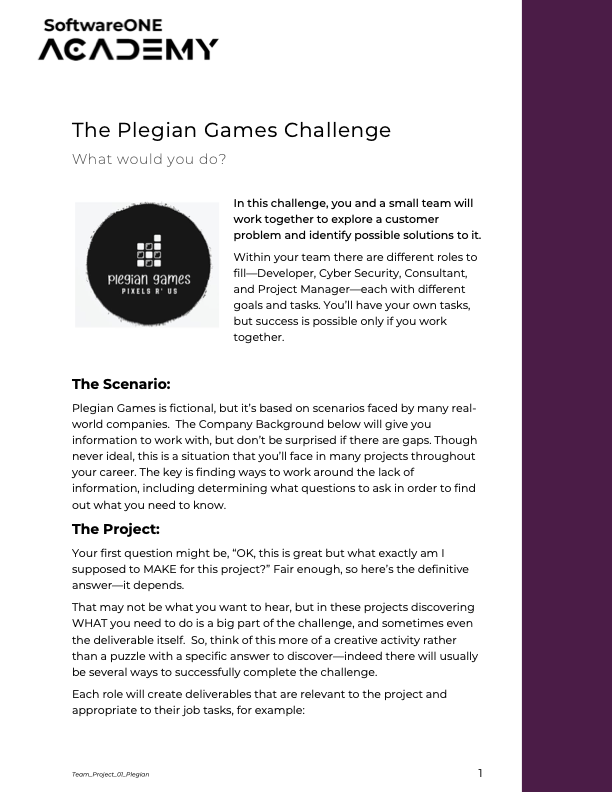
Around those strands, I built the structure that makes a virtual cohort work. Each participant joined a squad of three to five people from the same specialization, which they organized for peer support and project work. Every participant had a technical mentor, with a defined contact cadence in the first week (a one-to-one on day one, a group meeting in the first days, brief check-ins throughout) as well as mentor training and a mentor’s guide to make that consistent. Assessment was layered rather than test-based: a professional development plan built from a SWOT and skills audit and reviewed with the mentor, a learning journal, certifications, knowledge checks, and a role-based team project in which a Developer, a Consultant, a Cyber Security specialist, and a Project Manager had to solve a fictional customer’s problem together, each producing the deliverables their role would produce in real life. The program closed with a Futurespective: participants wrote the history of their next five years as if it had already happened, shared it, and turned it into goals.
I also built the system for producing the curriculum itself: designing the experience, vetting it with SMEs and business owners, packaging it, and hosting it (first in Articulate Rise, later in Docebo), with a participant-experience timeline for each cohort so everyone could see the full thirteen weeks at once.
In the first cohorts, I hosted much of the program myself: the kickoff, the weekly check-ins, and the closing ceremony. That instructor-host relationship was deliberate. For people who had never been inside a corporation, the program needed to create a sense of welcome and belonging as much as it needed to convey information and instill working habits. As the Academy scaled, regional Academy managers took over day-to-day delivery, sometimes in local languages, with hiring managers and SMEs joining as mentors. A separate apprenticeship track for younger students ran in France and Germany.
What was built
Cohort-specific participant-experience timelines, participant and mentor guides, the core-consulting program, the professional development plan and learning journal, the team challenge, the closing ceremony, and the weekly cadence that tied it all together. Approximately twenty cohorts, each of five to thirty participants, ran during the period I was involved.

Outcome
More than 300 people came through the Academy during the period I was involved, and the program had a 92% placement rate into roles in the company. Retention among Academy hires ran well above average for new hires, both initially and over the longer term. In some roles, such as customer support, managers reported that Academy graduates closed tickets at a higher rate and escalated less than most new hires, in some cases outperforming employees with far longer tenure.
What the business got was hard to buy: people trained on the specific cloud technologies it sells, arriving able to contribute in their first months. That took weight off managers and experienced peers who would otherwise have had to teach them from scratch. What participants got was a way in—and, by their own account, the confidence and sense of belonging that came from being taught how the business works rather than being left to guess.
What it shows
Zero-to-one program design and launch · Curriculum architecture across technical and professional strands · Cohort and mentor system design for virtual delivery · Multi-layered assessment · Global, distributed team leadership · Hiring-pipeline strategy tied to business capability gaps
Scott Parker · scott@sparkerlx.com · linkedin.com/in/scottparker4 · sparker.page