AI Strategy & Build
Three things built since 2025 with AI agents as the primary producers, the method that governs how they are built, and the work that came before it.
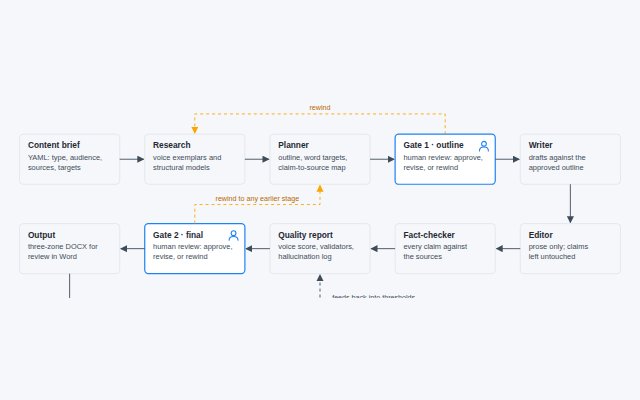
Content Garden
A content pipeline that has to be right, not just fluent
Read the case →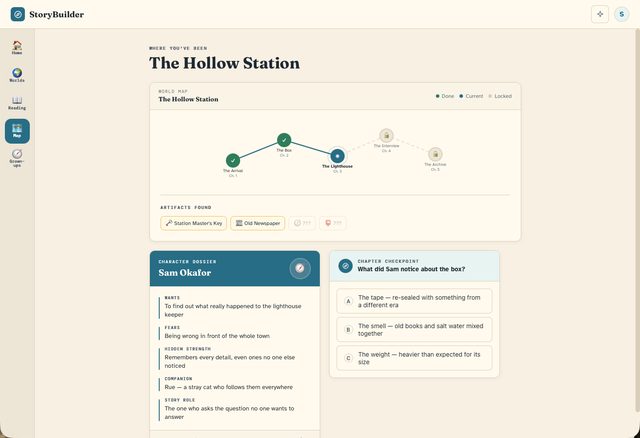
StoryBuilder
Every story is judged before a child sees it
Read the case →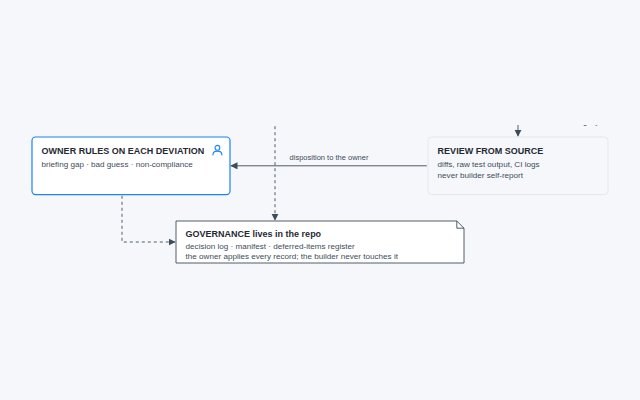
AI-Assisted Development Methodology
A way of building with AI agents that keeps the human accountable for every decision
Read the case →Before the method: two builds that worked, and showed me why I needed one
Both of these ran before the method existed, and both are the reason it does.
Bookmaker is a retrieval-augmented tool that ingested a doctoral thesis and a corpus of interview transcripts, built a citation-aware knowledge base, and produced a full book-plan outline for the author to review. Most of the scripts were generated in Perplexity, then adapted and hand-assembled around a Pinecone vector store with Zotero-linked citation checking; on top of that, I added a Claude Code multi-agent layer (research, style analysis, outlining, two author voices, consistency checking). It works. But it was built scattershot, with decisions made mid-execution and nothing written down, and that experience produced the method’s founding rule: deciding and building must not share a context.
The L&D simulator adapts AgentTorch, an agent-based simulation framework from MIT Media Lab, to model an organization at scale and test the long-term effects of learning interventions before running them, using an established L&D transformation framework as its organizing structure. The architecture, scripts, and a phased roadmap exist; testing and assembly were done by hand. It is queued for a full research and design pass under the method before it goes further. Of everything here, it is the idea I most want to finish.
StoryStill: simplifying a book without flattening it
Ask a language model to make a novel easier to read and you’ll usually get a plot summary: correct, short, and dead on the page. StoryStill is a skill that rewrites an existing children’s narrative to lower Lexile-approximate levels (three of them, from roughly 450L to 800L) while keeping what makes it a story: consequential scenes, the causal links between them, dialogue, interior response, sensory detail, and humor. The rubric treats “summary drift” as a measurable failure condition with explicit thresholds, not as a simplification strategy. I built it for one child, on one book; it’s now being moved to a self-hosted version with a public-domain title so the before-and-after can be shown.
Advisory: helping teams use AI properly
Most of the people I’ve advised were using a language model the way they use a search box: one prompt, one answer, then copy the result. The coaching is practical: system instructions and project-level context so the model stops re-learning who you are each session; thread and context management for multi-step work (such as building a course outline) so quality doesn’t decay as the conversation grows; and fact-checking and source discipline, because the failure modes run in both directions: people who avoid the tools because they think they’re a photocopier, and people who trust the output completely. And for those who want it, there’s an orientation to the engineering side (what it means to work with a coding agent such as Claude Code) so they can judge what’s possible rather than guess.